Mathematical Foundation of the REM Framework
The REM Framework (Recursive Emergent Mechanics) describes a discrete mechanical system using mathematical structures that represent nodes, relationships, states, and recursive evolution.
The mathematical model provides a formal language for describing how local interactions produce global system behavior.
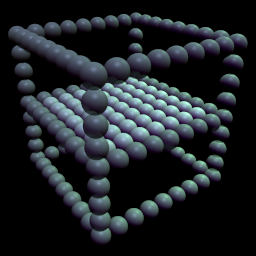
The framework is based on a discrete lattice where each element follows defined update rules and interacts with neighboring elements.
Lattice Representation
The fundamental structure of the REM Framework is a discrete lattice.
A lattice can be represented as a collection of nodes:
$$ L=\{N_1,N_2,N_3,...,N_m\} $$
where:
- $L$ represents the complete lattice.
- $N_i$ represents an individual node.
- $m$ represents the total number of nodes.
Each node has a defined position within the lattice.
For a three-dimensional lattice, the position of a node can be represented as:
$$ \vec{x_i}=(x_i,y_i,z_i) $$
where $\vec{x_i}$ represents the spatial position of node $i$.
Node State
Each node contains a set of properties that define its current mechanical state.
The state of a node can be represented as:
$$ N_i=(\vec{x_i},\vec{v_i},\vec{a_i}) $$
where:
- $\vec{x_i}$ represents the node position.
- $\vec{v_i}$ represents the node velocity.
- $\vec{a_i}$ represents the node acceleration.
The complete state of the lattice is determined by the combined state of all nodes.
$$ S=\{N_1,N_2,N_3,...,N_m\} $$
Neighbor Relationships
The REM Framework assumes that interactions occur through local neighbor relationships.
Each node has a defined set of connected neighboring nodes.
The neighbor relationship can be represented as:
$$ \mathcal{N}(N_i)=\{N_j,N_k,...\} $$
where $\mathcal{N}(N_i)$ represents the neighboring nodes connected to node $N_i$.
For a three-dimensional lattice with six directional connections, a node may interact with:
- positive X direction,
- negative X direction,
- positive Y direction,
- negative Y direction,
- positive Z direction,
- negative Z direction.
Local Interaction Function
The evolution of a node is determined by the influence of its neighboring nodes.
The local interaction can be represented as:
$$ I_i=G(N_i,\mathcal{N}(N_i)) $$
where:
- $I_i$ represents the interaction result for node $i$.
- $G$ represents the local interaction function.
This ensures that large-scale behavior emerges from repeated local interactions.
Recursive State Evolution
The REM Framework describes system evolution as a sequence of discrete updates.
At each update step, the current state of the system is transformed into the next state through the recursive update function:
$$ S_{n+1}=F(S_n) $$
where:
- $S_n$ represents the complete system state at update step $n$.
- $S_{n+1}$ represents the resulting state after the update.
- $F$ represents the complete recursive update mechanism.
The recursive update contains the rules that determine interactions, motion, oscillations, and other mechanical processes within the system.
Node Dynamics
The movement of nodes is determined by their position, velocity, and acceleration.
The acceleration of a node is calculated from the influence of its neighboring nodes and local interactions.
The velocity update can be represented as:
$$ \vec{v}_{n+1}=\vec{v}_n+\vec{a}_n $$
where:
- $\vec{v}_n$ represents the current velocity.
- $\vec{a}_n$ represents the calculated acceleration.
The position update is then calculated from the updated motion:
$$ \vec{x}_{n+1}=\vec{x}_n+\vec{v}_{n+1} $$
This creates a recursive mechanical evolution where the future configuration of the lattice depends on its previous configuration.
Gradient Measurement
The REM Framework uses local differences between neighboring nodes to measure directional changes within the lattice.
A gradient represents the difference between a node property and the corresponding properties of neighboring nodes.
For a scalar property $P$, the local gradient can be represented as:
$$ \nabla P_i=P_j-P_i $$
where:
- $P_i$ represents the property value at node $i$.
- $P_j$ represents the property value at a neighboring node.
The gradient provides a measure of local imbalance and can influence the resulting mechanical response of the system.
Identity Representation
An identity is represented as a localized dynamic structure within the lattice.
The mathematical representation of an identity may include:
$$ I=(N,f,A,\phi) $$
where:
- $N$ represents the occupied node location.
- $f$ represents the oscillation frequency.
- $A$ represents the oscillation amplitude.
- $\phi$ represents the phase information.
The identity is maintained through continuous recursive interaction with the surrounding lattice.
Occupancy Representation
Occupancy describes the relationship between an identity and a node.
The occupancy relation can be represented as:
$$ O(I,N) $$
where:
- $I$ represents the identity.
- $N$ represents the occupied node.
The occupancy relation determines where an identity exists within the lattice at a given update step.
Movement occurs when the occupancy relation transfers from one node to another:
$$ O(I,N_i)\rightarrow O(I,N_j) $$
where $N_j$ is a neighboring node selected according to the transport rules.
Pressure Representation
In the REM Framework, pressure is defined as an occupancy-local quantity.
Pressure belongs to the relationship between an identity and the occupied node rather than being an independent property of either element.
The pressure state can be represented as:
$$ P=P(I,N) $$
where:
- $P$ represents the occupancy pressure.
- $I$ represents the identity.
- $N$ represents the occupied node.
Pressure accumulation occurs through recursive interaction and may contribute to discrete transport when defined threshold conditions are reached.
Transport Mathematics
Within the REM Framework, identities do not move continuously through space. Instead, motion is represented by discrete transfers of occupancy between neighboring nodes.
An identity occupies exactly one node at any given recursive update step. Movement occurs only when the occupancy relationship is transferred to a neighboring node.
The occupancy transfer can be represented as:
$$ O(I,N_i)\rightarrow O(I,N_j) $$
where:
- $I$ represents the identity.
- $N_i$ represents the currently occupied node.
- $N_j$ represents the destination neighboring node.
Unlike continuous motion, transport within the REM Framework consists of a sequence of discrete occupancy transfers. Continuous trajectories therefore emerge from many individual transport events.
Pressure-Driven Transport
Transport is driven by the accumulation of occupancy-local pressure.
Pressure is generated through recursive interactions between an identity and the surrounding lattice. As neighboring nodes interact, pressure accumulates on the occupancy relationship until transport becomes possible.
The pressure associated with an occupied node is represented as:
$$ P=P(I,N) $$
Transport becomes possible when the accumulated pressure reaches a transport threshold:
$$ P \ge P_{\mathrm{threshold}} $$
Once the threshold is reached, the occupancy relationship may transfer to the neighboring node determined by the transport rules.
This mechanism naturally separates continuous wave propagation within the lattice from the discrete movement of identities.
Gradient-Directed Motion
The direction of transport is determined by the local mechanical environment.
The REM Framework evaluates directional gradients generated by neighboring interactions. These gradients provide directional information used during occupancy transfer.
The local gradient may be represented as:
$$ \vec{G}=\nabla M $$
where $M$ represents the measured mechanical quantity used to evaluate the local environment.
During transport, the destination node is selected according to the transport rules that evaluate the surrounding gradients and occupancy pressure.
Dynamic Stability
The lattice itself remains mechanically stable throughout recursive evolution.
Rather than transporting the lattice, the REM Framework transports occupancy relationships between stable lattice locations.
This distinction allows wave propagation to coexist with discrete transport while preserving the structural integrity of the lattice.
Stable structures therefore emerge from the interaction between:
- recursive node dynamics,
- oscillatory behavior,
- pressure accumulation,
- and occupancy transport.
Complete System Representation
At any recursive update step, the complete REM Framework can be described by:
$$ R=(L,S,O,P) $$
where:
- $L$ represents the lattice structure.
- $S$ represents the complete mechanical state of all nodes.
- $O$ represents the set of occupancy relationships.
- $P$ represents the occupancy-local pressure associated with each occupied node.
The recursive evolution of the REM Framework is therefore represented by:
$$ R_{n+1}=F(R_n) $$
where every recursive update simultaneously evolves the lattice mechanics, occupancy relationships, pressure accumulation, and transport behavior.
Summary
The mathematical structure of the REM Framework combines discrete mechanics with recursive evolution.
The framework is built upon:
- a discrete lattice of interconnected nodes,
- recursive node dynamics,
- localized identities,
- occupancy relationships,
- occupancy-local pressure,
- gradient-directed transport,
- and deterministic recursive evolution.
Together, these mathematical structures provide the formal foundation for investigating the emergence of increasingly complex physical behavior.
Next Article
Recursive Node Dynamics
The next article introduces the recursive mechanical equations that govern node behavior, including position, velocity, acceleration, local interactions, and wave propagation within the lattice.