Fundamental Concepts of the REM Framework
This article defines the fundamental concepts and terminology used throughout the REM Framework (Recursive Emergent Mechanics).
These definitions establish the foundation required for understanding the mathematical structure, recursive mechanics, simulations, and emergent phenomena described in later articles.
REM Framework
The REM Framework (Recursive Emergent Mechanics) is a research framework that investigates how complex physical phenomena may emerge from deterministic recursive mechanics operating within a discrete system.
The framework begins with fundamental mechanical elements and studies how repeated local interactions can produce higher-level structures and behaviors.
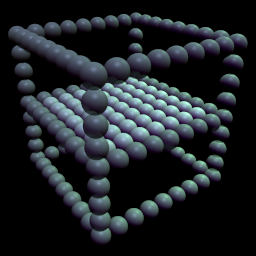
Discrete Lattice
A discrete lattice is the underlying spatial structure of the REM Framework.
The lattice consists of a finite or extendable collection of interconnected positions called nodes. Each node has defined relationships with neighboring nodes, allowing information and mechanical effects to propagate through local interactions.
Unlike a continuous space representation, the lattice describes space as a collection of discrete elements.
Node
A node is a fundamental element of the discrete lattice.
Each node represents a location within the lattice and contains the mechanical properties required for recursive evolution.
A node can participate in local interactions with neighboring nodes and contributes to the overall state of the system.
State
The state of the REM Framework represents the complete description of the system at a specific recursive update step.
The state contains all information required to determine the next state through the recursive update rules.
The evolution of the system can be represented as:
$$ S_{n+1}=F(S_n) $$
where $S_n$ represents the current state and $F$ represents the recursive update mechanism.
Recursive Update
A recursive update is the process by which the current state of the system determines the next state.
The REM Framework assumes that the evolution of the system occurs through repeated application of the same underlying update principles.
Each update depends on the previous state of the system rather than requiring external information about future states.
Identity
An identity is a localized dynamic structure within the REM Framework.
An identity represents a persistent pattern of activity that can occupy a location within the lattice and interact with the surrounding mechanical environment.
An identity is not defined as a fundamental particle. Instead, it is considered an emergent structure maintained through recursive interactions.
Occupancy
Occupancy describes the relationship between an identity and a node location in the lattice.
In the REM Framework, an identity occupies a node through a discrete occupancy relationship.
The occupancy relation provides the mechanism through which identities can move through the lattice by transferring between neighboring nodes.
Oscillation
An oscillation is a repeating dynamic variation within the system.
Oscillatory behavior represents a fundamental mechanism through which identities interact with the lattice and generate propagating disturbances.
Oscillations may occur in different directions and can contribute to emergent wave behavior.
Pressure
Pressure is a persistent scalar quantity associated with the occupancy relationship between an identity and a node.
In the REM Framework, pressure is not considered a property of the identity alone or the node alone. Instead, it belongs to the relationship created by an identity occupying a specific node.
Pressure can accumulate through recursive interactions and may influence transport behavior when defined conditions are reached.
Transport
Transport describes the discrete movement mechanism of identities through the lattice.
Rather than assuming continuous movement through space, the REM Framework describes motion as a sequence of occupancy transfers between neighboring nodes.
Transport emerges from the interaction between identity dynamics, pressure, and local lattice conditions.
Wave Propagation
Wave propagation describes the transmission of disturbances through the lattice.
A disturbance created at one location can influence neighboring nodes through recursive interactions, allowing patterns of oscillation to travel through the system.
Wave propagation is considered a developed mechanical behavior within the REM Framework.
Emergent Behavior
Emergent behavior describes higher-level properties that arise from the interaction of simpler underlying mechanisms.
In the REM Framework, phenomena are investigated as possible emergent consequences of recursive mechanics rather than being introduced as independent fundamental rules.
Examples of investigated emergent behavior include:
- stable structures,
- mass-like behavior,
- gravity-like behavior,
- electromagnetic field emergence.
Summary
The REM Framework begins with a small set of fundamental concepts:
- Discrete lattice
- Nodes
- Recursive updates
- Identities
- Occupancy
- Oscillations
- Pressure
- Transport
The purpose of the framework is to investigate how increasingly complex behavior can emerge from these fundamental mechanical principles.
Next Article
Axioms
The next article defines the fundamental assumptions and principles upon which the REM Framework is constructed.