Fundamental Principles of the REM Framework
The axioms of the REM Framework (Recursive Emergent Mechanics) define the fundamental assumptions upon which the framework is constructed.
These axioms establish the basic rules and principles used to describe the discrete system, its evolution, and the emergence of higher-level behavior.
The purpose of the axioms is not to directly describe all physical phenomena, but to define the minimal mechanical foundation from which such phenomena can be investigated.
Axiom 1: Discrete Structure
The REM Framework assumes that the fundamental structure of the system is discrete.
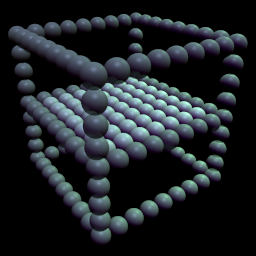
Space is represented as a collection of interconnected locations called nodes. These nodes form a lattice structure where each node has defined relationships with neighboring nodes.
The discrete lattice can be represented as:
$$ L=\{N_1,N_2,N_3,...,N_m\} $$
where $L$ represents the lattice and each $N_i$ represents an individual node.
The discrete structure provides the foundation for local interactions and recursive evolution.
Axiom 2: Local Interaction
The REM Framework assumes that interactions occur locally between connected elements of the lattice.
A node directly influences only its connected neighboring nodes. Global behavior emerges through the repeated propagation of local interactions.
The influence of a node can be represented as:
$$ N_i \rightarrow N_j $$
where $N_i$ affects neighboring node $N_j$ through defined mechanical rules.
This principle ensures that complex behavior develops from local processes rather than predefined global behavior.
Axiom 3: Recursive Evolution
The REM Framework assumes that the system evolves through repeated recursive updates.
The state of the system at a future update step is determined from the current state:
$$ S_{n+1}=F(S_n) $$
where:
- $S_n$ represents the current state of the system.
- $S_{n+1}$ represents the next state.
- $F$ represents the recursive update rules.
The same fundamental update mechanism is repeatedly applied throughout the evolution of the system.
Axiom 4: Deterministic Evolution
The REM Framework assumes that the evolution of the system follows deterministic mechanical rules.
Given the complete state of the system, the next state is determined by the recursive update mechanism.
This means that:
$$ S_n \rightarrow S_{n+1} $$
is defined by the rules of the framework and does not require random external input.
Deterministic evolution does not prevent complex behavior. Instead, complex behavior can emerge from the repeated interaction of simple deterministic processes.
Axiom 5: Emergence
The REM Framework assumes that higher-level phenomena can emerge from lower-level mechanical interactions.
The fundamental system does not require separate rules for every observed phenomenon. Instead, new behaviors may arise from the collective behavior of the underlying mechanics.
The general principle can be represented as:
$$ \text{Fundamental Mechanics} \rightarrow \text{Recursive Interactions} \rightarrow \text{Emergent Behavior} $$
Examples of investigated emergent behavior include:
- wave propagation,
- stable structures,
- mass-like behavior,
- gravity-like behavior,
- electromagnetic field behavior.
Axiom 6: Identity and Occupancy
The REM Framework assumes that persistent dynamic structures can exist within the lattice.
These structures are called identities.
An identity is not defined as a fundamental particle. Instead, it is a persistent pattern of activity maintained through recursive interactions with the lattice.
An identity exists within the lattice through an occupancy relationship:
$$ \text{Identity}+\text{Node}=\text{Occupancy} $$
Occupancy describes the relationship between an identity and its current lattice location.
Movement occurs through discrete transfer of occupancy between neighboring nodes rather than continuous movement through space.
Axiom 7: Occupancy-Local Pressure
The REM Framework assumes that pressure is associated with the occupancy relationship between an identity and a node.
Pressure is not considered an inherent property of the identity or the node independently. Instead, it exists as a property of the interaction created by occupancy.
This relationship can be represented as:
$$ P=P(I,N) $$
where:
- $P$ represents occupancy pressure.
- $I$ represents the identity.
- $N$ represents the occupied node.
Pressure can accumulate through recursive interactions and can influence transport when defined conditions are reached.
Axiom 8: Stability Through Dynamic Balance
The REM Framework assumes that stable structures can emerge from balanced recursive interactions.
A stable structure does not require the absence of motion. Instead, stability may arise from continuous dynamic processes maintaining a persistent pattern.
The framework investigates stability as an emergent result of:
- local interactions,
- recursive updates,
- oscillatory behavior,
- energy redistribution.
Summary of Axioms
The REM Framework is built upon the following fundamental principles:
- Discrete Structure: The system is represented by interconnected discrete nodes.
- Local Interaction: Nodes influence their connected neighbors through mechanical rules.
- Recursive Evolution: The system evolves through repeated state updates.
- Deterministic Evolution: The future state follows from the current state.
- Emergence: Higher-level behavior arises from lower-level interactions.
- Identity and Occupancy: Persistent structures exist through relationships with lattice locations.
- Occupancy-Local Pressure: Pressure belongs to the identity-node relationship.
- Dynamic Stability: Stable structures emerge through balanced recursive processes.
Next Article
Mathematical Structure
The next article defines the mathematical representation of the REM Framework, including:
- lattice representation,
- node states,
- neighbor relationships,
- recursive update equations,
- and the mathematical description of emergent behavior.