Overview
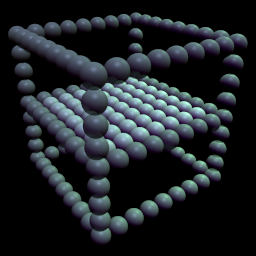
Recursive node dynamics describe the fundamental mechanical behavior of the lattice within the REM Framework. Every node evolves according to the same deterministic update rules, interacting only with its neighboring nodes.
The collective behavior of these local interactions gives rise to wave propagation and forms the mechanical foundation from which higher-level phenomena may emerge.
Each recursive update consists of three fundamental stages:
- Measure the local mechanical environment.
- Calculate the resulting acceleration.
- Update the node state.
Node Properties
Each node stores a small set of mechanical properties that completely describe its state.
The node state is represented as:
$$ N=(\vec{x},\vec{v},\vec{a}) $$
where:
- $\vec{x}$ is the node position.
- $\vec{v}$ is the node velocity.
- $\vec{a}$ is the node acceleration.
These quantities are updated recursively during every simulation step.
Neighbour Interactions
Nodes do not evolve independently. Each node interacts only with its directly connected neighbouring nodes.
For the current implementation, every node may have up to six neighbours:
- $+X$
- $-X$
- $+Y$
- $-Y$
- $+Z$
- $-Z$
Boundary nodes simply have fewer neighbours. The recursive update automatically adapts to the available connections.
Mechanical Measurement
Before a node can update its motion, it first measures the mechanical state of its local neighbourhood.
Rather than responding to distant nodes, every measurement is performed using only neighbouring nodes. This locality is one of the fundamental principles of the REM Framework.
The measured differences provide the information required to determine the node's next acceleration.
Recursive Update Cycle
The recursive evolution of every node follows the same sequence:
$$ \text{Measure Local State} $$
$$ \downarrow $$
$$ \text{Calculate Acceleration} $$
$$ \downarrow $$
$$ \text{Update Velocity} $$
$$ \downarrow $$
$$ \text{Update Position} $$
$$ \downarrow $$
$$ \text{Repeat} $$
Every node executes this cycle during each recursive update step, producing a deterministic evolution of the lattice.
Wave Propagation
A disturbance introduced into the lattice changes the local mechanical state of neighbouring nodes. During subsequent recursive updates, this disturbance propagates through the lattice as each node responds to the changing conditions around it.
Wave propagation therefore emerges naturally from repeated local interactions rather than being introduced as a separate mechanism.