Overview
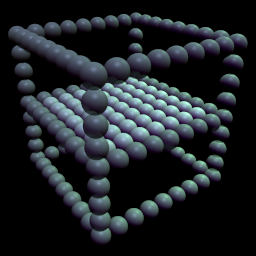
The Fundamental Node Equation is the core mechanical equation of the Recursive Emergent Mechanics (REM) Framework. It defines how every node within the discrete lattice responds to the positions of its directly connected neighbouring nodes.
Unlike classical equations of motion that often begin with externally applied forces, the REM Framework derives motion from local mechanical interactions. Each node measures only the relative positions of its neighbours, producing a restoring acceleration whenever the local neighbourhood deviates from equilibrium.
This single recursive equation forms the mechanical foundation of the entire framework. Wave propagation, interference, identity oscillations, occupancy transport, and the higher-level emergent phenomena described later all originate from repeated applications of this equation.
Mechanical Principle
The REM Framework is based on a simple mechanical principle:
A node never responds to absolute position. It responds only to the relative positions of its neighbouring nodes.
Because every node follows the same local rule, the lattice behaves as a distributed mechanical system. Local disturbances generate restoring accelerations that propagate recursively throughout the lattice while preserving its equilibrium configuration.
The Fundamental Node Equation
The acceleration of every node is determined by the average positional difference between the node and its neighbouring nodes.
$$ \mathbf{a} = \frac{k^{2}}{|N|} \sum_{n\in N} (\mathbf{n}-\mathbf{p}) $$
where:
- $\mathbf{a}$ = node acceleration
- $\mathbf{p}$ = current node position
- $\mathbf{n}$ = neighbouring node position
- $|N|$ = number of neighbouring nodes
- $k$ = wave-speed constant
For a regular three-dimensional lattice, each node has up to six neighbouring nodes, giving $$|N|=6$$ for interior nodes. Boundary nodes naturally contain fewer neighbours and are evaluated using only their existing neighbour connections.
Interpretation
The Fundamental Node Equation measures the local mechanical imbalance surrounding a node. If all neighbouring positions remain in perfect equilibrium, the average positional difference is zero and the resulting acceleration is also zero.
When one or more neighbouring nodes are displaced, the local balance is disturbed. The equation immediately generates a restoring acceleration that acts to reduce this imbalance. As neighbouring nodes respond in subsequent recursive updates, the disturbance propagates naturally through the lattice as a mechanical wave.
This behaviour is entirely local. No node possesses knowledge of the global lattice or of distant nodes. Every update depends exclusively on information obtained from directly connected neighbours.
Recursive Time Evolution
The REM Framework does not include an explicit time variable within the Fundamental Node Equation. Instead, temporal evolution is represented by recursive state updates. Each application of the equation advances the mechanical state of the lattice by one recursive step.
Consequently, repeated recursive application of the Fundamental Node Equation defines the evolution of the entire mechanical system.
Relationship to the REM Framework
The Fundamental Node Equation is the first and most fundamental mechanical equation of the REM Framework. All higher-level mechanisms introduced in later chapters build upon the recursive behaviour established by this equation.
Subsequent articles describe how recursive node dynamics produce wave propagation, how oscillating identities interact with the lattice, and how occupancy, pressure, and transport give rise to increasingly complex emergent behaviour.
Key Takeaways
- The Fundamental Node Equation defines the acceleration of every node in the lattice.
- Acceleration is determined solely by the average positional differences between neighbouring nodes.
- Only local neighbour information is required.
- Recursive updates replace an explicit time variable.
- The equation provides the mechanical foundation for all higher-level behaviour within the REM Framework.
Why the Fundamental Node Equation Is Stable
One of the defining characteristics of the Fundamental Node Equation is that it naturally preserves the equilibrium of the lattice. This stability is not introduced through additional correction terms or external constraints, but emerges directly from the recursive structure of the equation itself.
Consider a lattice in its equilibrium configuration. Every node occupies its equilibrium position, and each neighbouring node is positioned symmetrically around it.
The sum of the positional differences between the node and all of its neighbours therefore becomes:
$$ \sum_{n\in N} (\mathbf{n}-\mathbf{p}) = \mathbf{0} $$
Substituting this result into the Fundamental Node Equation immediately gives:
$$ \mathbf{a} = \mathbf{0} $$
Since the acceleration is zero, the velocity remains unchanged. If the lattice is initially at rest, the velocity is also zero, and the node therefore remains at its current position.
Because the position does not change, the neighbouring positional differences remain unchanged during the next recursive update. The acceleration therefore remains zero again.
This recursive process repeats indefinitely, preserving the equilibrium configuration of the lattice without requiring any additional stabilization mechanism.
The equilibrium state is therefore a self-consistent recursive solution of the Fundamental Node Equation.
A Locally Self-Correcting System
When a node is displaced from its equilibrium position, the balance between its neighbouring nodes is disturbed. The average positional difference is no longer zero, causing the Fundamental Node Equation to generate a restoring acceleration directed toward the local equilibrium configuration.
As neighbouring nodes respond to this disturbance during subsequent recursive updates, the restoring behaviour propagates naturally throughout the lattice. The disturbance is therefore distributed across neighbouring nodes rather than remaining localized.
The lattice behaves as an elastic mechanical medium. Local disturbances generate restoring accelerations that are distributed recursively through neighbouring nodes, allowing mechanical waves to propagate while preserving the lattice's equilibrium configuration.
A mechanically consistent recursive lattice must possess a locally self-correcting update rule. Without such a restoring mechanism, recursive evolution cannot maintain a stable spatial structure.
Locality
The REM Framework is based upon the principle of locality. Every node interacts exclusively with its directly connected neighbouring nodes. No node possesses knowledge of the global lattice, the position of distant nodes, or the overall state of the system.
During each recursive update, a node measures only the relative positional differences between itself and its neighbouring nodes. These local measurements are sufficient to determine the node's acceleration through the Fundamental Node Equation.
Consequently, every change within the lattice originates from local mechanical interactions. Information is never transmitted instantaneously across the lattice but propagates recursively from one neighbouring node to the next.
This locality is one of the defining characteristics of the REM Framework. Complex global behaviour is not prescribed by global equations or external coordination. Instead, it emerges naturally from the repeated application of simple local interactions throughout the lattice.
Because every node follows exactly the same mechanical rule, the lattice behaves as a unified mechanical system while each individual node remains aware only of its immediate surroundings.
Recursive Evolution
The evolution of the REM Framework is entirely recursive. During each update, every node evaluates the current state of its neighbouring nodes, calculates its new acceleration, and updates its mechanical state. The resulting lattice configuration becomes the input for the next recursive update.
Unlike many mathematical formulations, the Fundamental Node Equation does not contain an explicit time variable. The progression of the simulation is instead represented by the repeated application of the recursive update itself.
Within the REM Framework, temporal evolution is therefore represented by recursive state updates. Each application of the Fundamental Node Equation advances the mechanical state of the lattice by one recursive step.
The recursive update is therefore not simply a numerical implementation technique. It is an integral part of the mathematical structure of the REM Framework and defines how the lattice evolves over time.
From Local Motion to Wave Propagation
When a node is displaced from its equilibrium position, the resulting restoring acceleration affects only that node during the current recursive update. During the following updates, neighbouring nodes respond to the change in position, generating their own restoring accelerations.
This sequential transfer of mechanical disturbance causes the motion to propagate throughout the lattice. The wave is therefore not transported as a separate object but emerges naturally from the recursive interactions between neighbouring nodes.
Wave propagation is therefore an inherent consequence of the Fundamental Node Equation. No additional propagation algorithm, transmission rule, or wave equation is required. The recursive mechanical interactions alone produce the observed propagation of disturbances through the lattice.
Summary
The Fundamental Node Equation establishes the fundamental mechanics of the REM Framework. By combining local neighbour interactions with recursive updates, it produces a stable mechanical lattice capable of supporting propagating disturbances while continuously preserving its equilibrium configuration.
This equation serves as the foundation upon which all subsequent mechanisms of the REM Framework are constructed. The following articles build upon this foundation by introducing recursive node dynamics, identity oscillations, occupancy, pressure, transport, and the higher-level emergent phenomena that arise from these interactions.
Key Takeaways
- The Fundamental Node Equation is the fundamental mechanical equation of the REM Framework.
- Every node responds only to its directly connected neighbouring nodes.
- The lattice is locally self-correcting and naturally preserves its equilibrium configuration.
- Recursive state updates replace an explicit time variable.
- Wave propagation emerges naturally from recursive local interactions.
- The Fundamental Node Equation provides the foundation for all higher-level mechanisms within the REM Framework.